Categories
Business

Understanding Pending, Authorized, Captured, and Settled Statuses in Online Payment Records

When a customer clicks “Pay,” several systems may become involved: the merchant’s website, a payment gateway or processor, the acquiring institution, the card network, and the cardholder’s issuing bank. The merchant’s bank payout may occur separately after the payment itself has been processed. Pending, Authorized, Captured, and Settled are useful terms, but they are not a universal four-step status system used identically by every bank and payment provider. Stripe, for example, uses statuses such as processing, requires_capture, and succeeded, while Adyen uses labels including Open, Authorised, SentForSettle, and Settled. A customer’s banking app may use “Pending” differently from the merchant’s payment dashboard.

Core Differences Between Pending, Authorized, Captured, and Settled

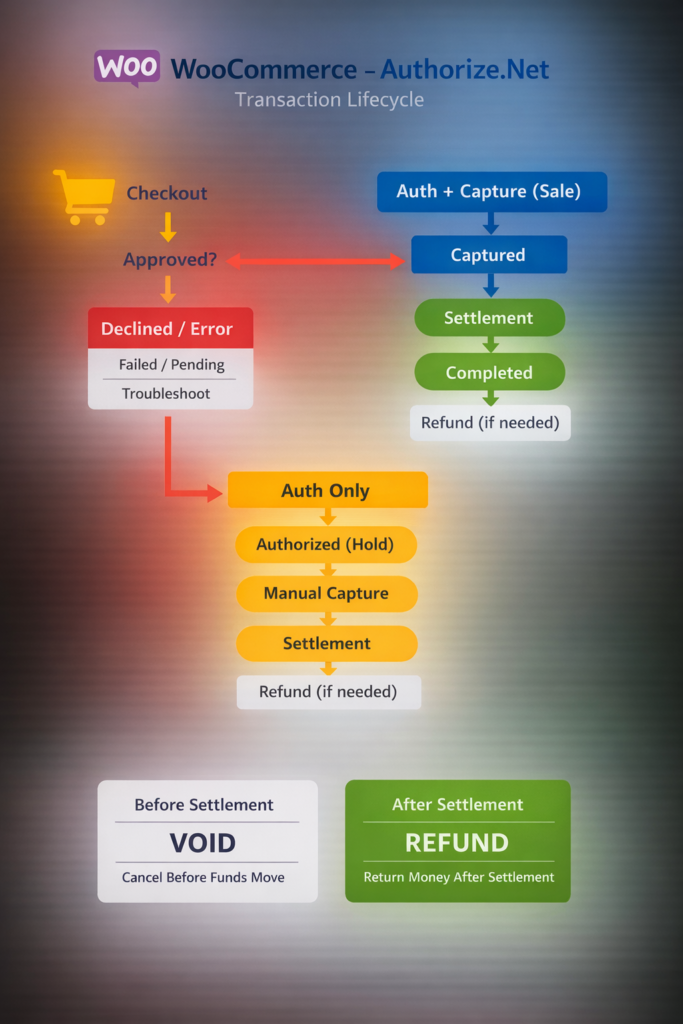
A card payment that uses separate authorization and capture may broadly follow this path:

[1. Pending] ──► [2. Authorized] ──► [3. Captured] ──► [4. Settled]
(Processing) (Amount Reserved) (Payment Submitted) (Funds Received by Processor)

Some payments combine authorization and capture immediately. Other payment methods use a different sequence and may remain asynchronous for several days.

What Is Pending? Why Is Your Transaction On Hold in the System?

Concept: Pending generally means that a payment-related action has started but has not reached a final result. It does not identify one precise technical stage.

Technical Mechanism: A payment can remain pending while the customer completes authentication, while the processor waits for a bank response, or while an asynchronous payment method confirms the transfer. Adyen, for example, uses an Open status when authorization is pending, including cases involving redirects or 3D Secure authentication. Stripe uses processing for PaymentIntents that are still being processed.

On a bank statement, “Pending” often refers to an authorized card transaction that has not yet been posted as a final charge. Therefore, the customer’s balance display and the merchant’s payment status may not use the same wording.

What Is Authorized? Has Money Actually Left the Account?

Concept: Authorized means the issuer or relevant financial institution approved the payment request. For card payments using delayed capture, the issuer normally reserves the amount against the customer’s available credit or balance.

Technical Mechanism: The merchant has permission to capture up to the approved amount within the authorization period. Authorization does not always mean that the merchant has received funds, and it does not eliminate the possibility of an expired or failed capture. Stripe describes authorization as the issuer validating the payment and reserving sufficient funds while waiting for capture. Adyen similarly describes an authorized payment as approved by the financial institution but still awaiting capture.

Real-World Example: Hotels and car-rental companies may authorize an estimated amount before the final charge is known. The final amount may later be adjusted, captured, partially captured, or reversed according to the merchant’s procedures and network rules.

What Is Captured? The Critical Step for Merchants to Claim Funds

Concept: Capture is the merchant’s instruction to complete an authorized payment.

Technical Mechanism: The processor submits the captured amount for clearing and settlement. Capture may happen automatically immediately after authorization, manually when an order is fulfilled, or in separate partial amounts for split shipments.

It is inaccurate to state that every merchant captures only after packing or dispatch. Adyen and Stripe both support manual capture, but automatic capture is also common. The correct timing depends on the merchant’s business model and agreement with the payment provider.

A captured payment may still be waiting for confirmation from the financial system. Adyen labels this stage SentForSettle and notes that the payment can no longer be canceled through the ordinary cancellation process once that stage is reached.

What Is Settled? The Final Milestone When Funds Arrive in Merchant Accounts

Concept: Settled usually means that clearing and settlement for the payment have been completed at a defined point in the processor’s system.

Technical Mechanism: The precise meaning depends on the provider. In Adyen’s lifecycle, Settled means Adyen has received the payment funds, but it explicitly does not necessarily mean that those funds have already been paid to the merchant’s external bank account. The merchant payout follows the applicable payout model and schedule.

Stripe also separates payment settlement timing from payout scheduling. Funds may first become available in the merchant’s processor balance and then be sent to the external bank account according to a country- and account-specific payout schedule.

A settled transaction is not immutable. It may later be refunded, disputed, charged back, or adjusted.

Status Typical Position of Funds Has the Seller Received a Bank Payout? Typical Cancellation Method
Pending Status is unresolved or processing No Depends on the payment method and processor
Authorized Reserved against the customer’s available balance or credit No Cancel or send an authorization reversal where supported
Captured Submitted for clearing and settlement Not necessarily Usually refund or reversal, depending on processing stage
Settled Received at the processor or acquiring level Not necessarily; payout may be separate Refund; disputes may still occur

Diagram explaining how pending, authorized, captured, settled, and merchant payout differ.

An Accountant’s Nightmare: How Unsettled Transactions Impact Business Bookkeeping

Real-World Cash Flow Discrepancies

Payment settlement and revenue recognition are separate accounting questions.

Suppose a customer places an order on December 31, the payment is authorized that day, and the goods are delivered on January 2. Authorization alone does not normally establish that revenue belongs in the earlier period. Under IFRS 15, an entity recognizes revenue when or as it satisfies a performance obligation by transferring the promised goods or services to the customer.

The reverse situation is also possible. If control of the goods transfers to the customer on December 31 but the payment processor settles or pays out the transaction in January, revenue may still belong to December, depending on the contractual terms and applicable accounting policy. The unsettled amount may instead be recorded through a receivable or payment-processor clearing account.

Therefore:

  • Authorization is not automatically revenue.
  • Settlement is not automatically the revenue-recognition date.
  • A bank payout is not necessarily a new sale.

The business must separate order fulfillment, revenue recognition, processor settlement, fees, refunds, and bank deposits.

Practical Solutions From Modern ERP Systems

The original claim that modern systems export only settled transactions to the general ledger is incorrect. ERP and accounting integrations can record orders, invoices, receivables, captured payments, processor balances, fees, refunds, disputes, and payouts at different stages.

Adyen’s Payment Accounting Report, for example, contains lifecycle changes and modifications across transactions rather than only final settlements. Its settlement reports can then be used to match processed payments and fees with payouts.

A practical reconciliation structure is:

  • Record the sale according to the applicable revenue-recognition policy.
  • Record the customer payment in a payment-processor clearing account.
  • Record processing fees and payment adjustments separately.
  • Match captured and settled transactions against the processor report.
  • Match processor payouts against bank-statement deposits.
  • Investigate differences caused by fees, currency conversion, refunds, reserves, disputes, or timing.
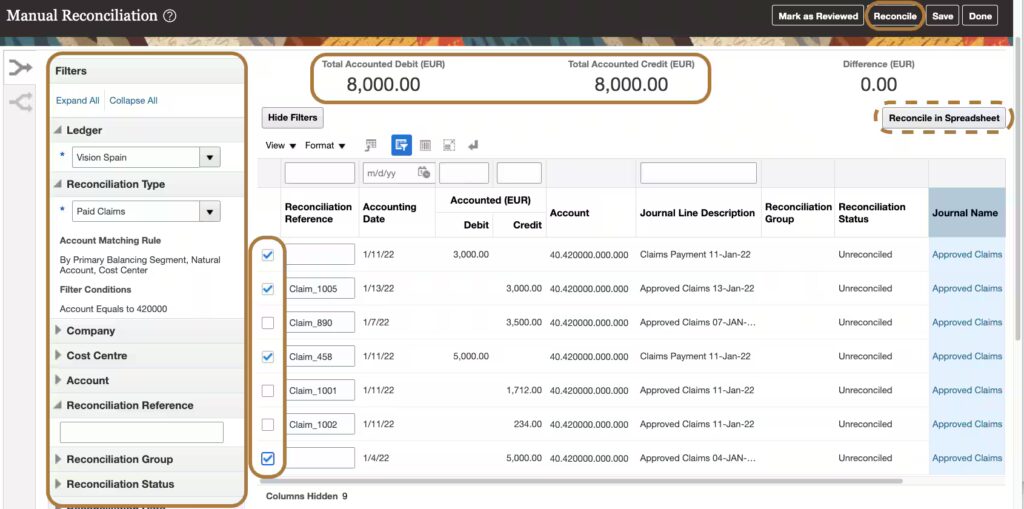
Payment processor clearing account connecting sales records, settlement reports, fees, and bank payouts.

Essential Rules Businesses Must Know to Avoid Pitfalls During Refunds

Void vs. Refund

Canceling during Authorized status: When an authorized payment has not been captured, a merchant may cancel it or send an authorization reversal. The reversal tells the issuer that the sale will not be completed and that the hold should be removed. Release is not always immediate because the issuer must receive and match the reversal with the original authorization.

It is inaccurate to promise that the customer’s available balance will be restored instantly or that every void has zero cost. Pricing and operational rules depend on the payment provider and merchant agreement.

Canceling after Capture: Once funds have been captured, the merchant will generally need a refund or another supported reversal operation. Adyen instructs merchants to cancel an authorized but uncaptured payment and refund a payment that has already been captured.

Refund fees are not universal. Stripe states that a payment canceled before completion can be canceled without cost under its standard flow, while refunds may incur fees and the original processing fees are generally not returned. Other providers and custom contracts may apply different terms.

The time before a refund appears in the customer’s account also varies by payment method, processor, bank, country, and refund outcome. A fixed promise of three to ten business days is not reliable for every transaction.

Authorization Hold Window

There is no universal authorization window of seven to thirty days.

Validity depends on factors including:

  • Card brand.
  • Card-present or card-not-present processing.
  • Merchant category.
  • Customer-initiated or merchant-initiated status.
  • Payment method.
  • Processor configuration.
  • Eligibility for extended authorization.

Stripe’s published card-present windows, for example, list five days for Visa and two days for Mastercard, American Express, and Discover in its standard Terminal flow, while eligible extended authorizations may remain capturable for up to 30 days. Other online and non-card methods have different limits.

Merchants should read the current authorization rules shown by their own payment provider and monitor authorization-expiry timestamps rather than relying on a general range.

Why Are Transactions Refused or Marked as Error?

Not every provider uses the words Refused and Error, but they commonly represent different outcomes:

              ┌──► Refused or Declined  

[Payment Request] │ (Issuer, Network, Risk, or Validation Decision)
└──► Error or Processing Failure
(Communication or Technical Problem)

Fraud Scoring & Security Checks

Payment processors may use configurable rules, machine-learning models, lists, device information, transaction history, and authentication results to assess risk.

There is no universal rule that an Adyen score above 99 always causes every transaction to be declined. Adyen documents a FRAUD-CANCELLED refusal reason when the combined fraud score reaches 100 or more, but actual risk configuration and refusal reasons remain specific to the merchant’s setup and processing flow.

A card can also be refused by the issuing bank or card network for suspected fraud, restrictions, failed verification, invalid data, or other policy reasons.

Insufficient Funds

The issuer may decline a transaction when the available balance or credit is insufficient. The merchant usually receives a standardized or processor-mapped decline reason but may not receive detailed information about the customer’s account.

The customer may need to use another payment method or contact the issuer. Repeatedly retrying an unchanged declined payment can be ineffective and may conflict with network or processor retry guidance.

Technical & AVS Errors

Data Mismatches: An invalid card number, expiration date, or security code may lead to a decline. Address Verification Service and CVC results do not produce identical outcomes for all merchants because acceptance rules can be configured differently.

Technical Error: A communication failure can occur between the merchant, processor, acquirer, network, or issuer. Adyen defines its Error status as a communication problem in which funds were not processed.

A user should not always retry immediately after a timeout. The merchant should first check the transaction reference, payment status, webhook events, and idempotency controls to avoid creating a duplicate charge. Only retry after confirming that the original attempt did not complete.

Difference between a declined transaction and a technical payment-processing error.

Pending, Authorized, Captured, and Settled describe useful payment concepts, but their exact meanings depend on the bank, card network, payment method, and processor. For Consumers: An authorization or pending entry may reduce the available balance without being a final posted charge. If a payment is canceled, the issuing bank controls when the hold disappears. Contact the merchant first and then the bank if the hold remains longer than expected. For Merchants: Do not treat authorization, capture, settlement, payout, and revenue recognition as the same event. Use the processor’s lifecycle reports, a payment-clearing account, fulfillment records, refund data, and bank statements together. This produces more accurate accounting than sending only transactions labeled “Settled” to the general ledger.


Categories
Business

Why the Same Product Is Sold With Different Model Names and Included Accessories on Country-Specific Official Stores

A product can look identical across a brand’s regional stores while carrying a different model number, SIM configuration, wireless specification, keyboard layout, warranty policy, or accessory bundle. In other cases, the hardware is unchanged and only the commercial name, color selection, packaging language, or promotional bundle differs. These variations are not governed by one universal rule. Buyers need to compare the complete model number and regional specifications rather than assuming that products sharing a marketing name are interchangeable.

Why Are Identical Products Sold Under Completely Different Names in Different Countries?

Regional naming can reflect branding decisions, trademark availability, sales channels, and differences between product configurations.

Market Tier Positioning: A manufacturer may place similar hardware in different product families or price tiers depending on the local range and competing products. A different name does not necessarily mean that the device has been technically downgraded. The specifications and model number must be compared separately.

Technical SKU Encoding (SKU Suffixes): Regional model codes help manufacturers distinguish configurations, distribution channels, colors, storage capacities, SIM support, and service parts. Samsung’s official regional support pages, for example, identify the Galaxy S24 Ultra as SM-S928B/DS in several markets. The longer sales code varies further by country and color. However, buyers should not treat one letter as a permanent universal code for a chipset, carrier lock, or region across every Samsung generation.

Local Consumer Psychology: Claims that consumers in one country prefer numeric names while another market prefers emotional names are difficult to prove for a specific product. A more practical explanation is that regional subsidiaries adapt names to the existing product portfolio, language, retailer requirements, and local brand strategy.

Why Do Official Product Boxes Include Full Accessories in One Country but Suffer Severe Cuts in Another?

The contents of a retail box can vary by model, country, seller, and promotion. A power adapter may be included in one version, sold separately in another, or added by a retailer rather than packed by the manufacturer.

Global Plug Standards and Voltage Variations: When a wall adapter is included, its plug must be suitable for the destination market. Many modern adapters support a broad input-voltage range, but the plug shape remains region-specific. This is one reason manufacturers use separate regional packages or sell the adapter independently.

Retail Point-of-Sale Pressure: Local competition and promotional strategy can influence bundles, but it is inaccurate to claim that developing markets always receive more accessories while mature markets receive fewer. A case, charger, or screen protector shown on a store page may be a temporary gift rather than a factory-sealed accessory. Buyers should separate the official “In the Box” list from retailer bonuses.

Comparison of regional power adapters and official product box contents.

Trademark and Intellectual Property Conflicts: When Global Brands Collide With Local Trademarks

Trademark rights are territorial. A name available in one country may conflict with an existing registration or established brand in another. WIPO defines a trademark as a sign that distinguishes one enterprise’s goods or services from those of another, and protection is obtained under the applicable national or international registration system.

A company may therefore use another name, negotiate permission, or redesign its branding before entering a market. Trademark conflicts are one possible reason for regional naming, but they are not the explanation for every renamed product.

Real-World Examples:

Mazda’s roadster illustrates regional branding rather than a simple forced renaming. Mazda officially refers to the vehicle as the MX-5, the MX-5 Miata in North America, and the Roadster in Japan. Earlier Japanese models were sold under the Eunos Roadster name. Mazda’s own history confirms these regional names, but does not establish that European trademark law forced the use of MX-5.

Strict Government Regulations and Safety Standards in Each Country

Regional compliance rules can require separate testing, labels, documentation, software settings, or hardware configurations.

E-Waste Reduction Directives: The EU’s common-charger rules require covered categories of portable electronic equipment to use USB-C and provide consumers with clear information about charging requirements. They also allow consumers to purchase covered devices without a charger. The rules do not require every manufacturer to remove the charger from every box, nor do they provide a general tax reduction for doing so.

Mandatory Regional Compliance Certifications: Radio-frequency equipment marketed or imported into the United States must follow the appropriate FCC equipment-authorization procedure. In the European Economic Area, covered products may require CE marking to declare conformity with applicable EU legislation. CE marking is not always a third-party “certification,” and RoHS compliance is a separate legal obligation concerning restricted substances.

Wireless Spectrum Allocation Restrictions: Countries allocate and license spectrum differently. Manufacturers may enable different cellular bands, antennas, or radio features for particular markets. GSMA materials show that mobile networks use several frequency ranges and that spectrum availability differs between countries. Buyers should therefore compare the exact supported bands instead of relying on the product name alone.

Differences in Local Consumer Habits and Practical Needs

Regional variants may differ in SIM configuration, software availability, keyboard layout, language support, and camera behavior. These differences must be checked by exact model and release year.

MarketPossible Regional DifferenceWhat Buyers Should Verify
China mainland, Hong Kong, or MacaoCertain phone models may have different physical-SIM or eSIM configurationsExact model number, number of supported lines, and carrier compatibility
United States and selected newer marketsSome iPhone versions are eSIM-onlyWhether the destination carrier supports eSIM activation
Japan and certain other regionsSome devices may prevent the camera shutter sound from being mutedManufacturer documentation for the exact model and region
Europe and other multilingual marketsLaptop keyboard layouts and printed symbols may differPhysical keyboard layout, language, and replacement-key availability

Apple’s current SIM documentation shows why broad regional claims quickly become outdated. For example, all iPhone 14-or-later models originally sold in the United States are eSIM-only, while the list of eSIM-only countries is broader for some newer generations. Other versions may support both nano-SIM and eSIM.

Apple also states only that the camera shutter cannot be muted in “some countries and regions.” It does not attribute this behavior universally to a named anti-voyeurism law, so buyers should avoid repeating that explanation as a confirmed legal requirement.

Extreme Weather and Climate Factors Forcing Component Adjustments

Regional climate modifications are common in specialized industrial, automotive, marine, or outdoor equipment, but they should not be assumed for ordinary consumer electronics.

Thermal Management Hardware: A phone or laptop sold in a hot country is not automatically equipped with a larger vapor chamber, different thermal paste, or faster fan than the same model sold elsewhere. Such a difference should appear in the manufacturer’s specifications, service manual, regulatory filing, or teardown of the exact model.

Battery Chemistry in Sub-Zero Climates: Lithium-ion performance is affected by temperature, but this does not prove that retail devices in colder countries receive different batteries or power-management chips. Manufacturers generally publish one operating-temperature range for a model unless a regional specification states otherwise.

Conformal PCB Coating: Moisture-resistant coatings may be used in products designed for harsh environments. The claim that consumer PCBs sold in tropical markets routinely receive an additional coating requires model-specific evidence.

Buyers should treat undocumented climate-based hardware claims as speculation.

Local Taxes, Operational Costs, and Purchasing Power Parity (PPP)

Import tariffs, domestic taxes, exchange rates, local assembly, retailer margins, and distribution costs can change regional pricing. The WTO defines tariffs as customs duties on imports and notes that they can raise the domestic price of imported goods.

Import Tariffs and Luxury Taxes: Local assembly can reduce certain import costs in some circumstances, but labels such as CBU or CKD do not automatically explain a model-code difference. The tax treatment depends on the product classification and the destination country’s rules.

Cost-Cutting to Preserve Price Ceilings: A manufacturer may adjust storage capacity, materials, accessories, or promotions to reach a regional price target. It may also keep the product unchanged and accept a different retail price. The box contents alone do not reveal the company’s reason.

Pressure From Freight Costs and the Problem of Shipping Empty Space

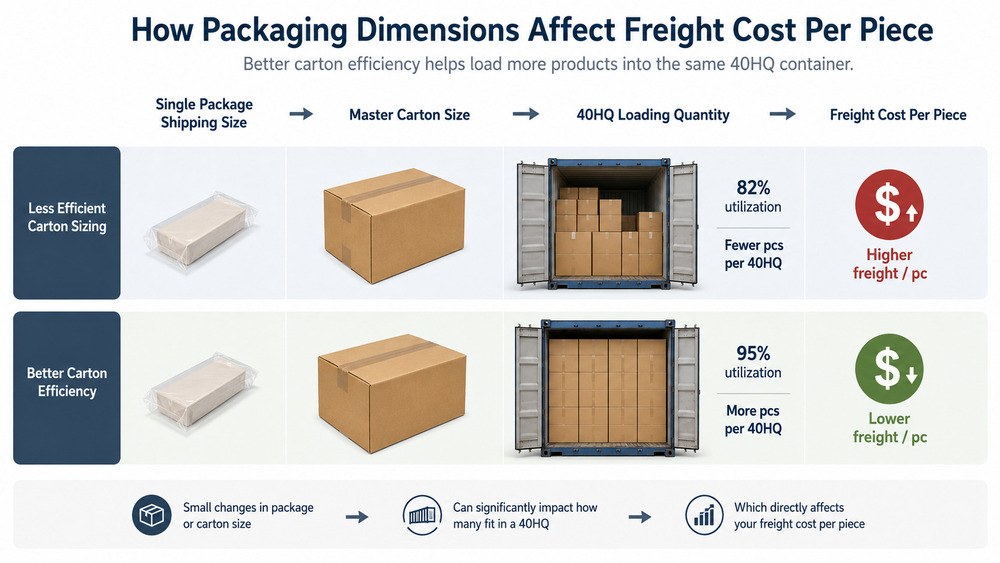
Smaller packaging can reduce material use and increase the number of units carried on a pallet or shipment, but the benefit depends on the product and the redesigned dimensions.

Logistics comparison showing how smaller retail packaging can increase pallet density.

Eliminating Wasted Air Volume in Containers: Removing a large accessory can make a package thinner, but a box that is 50% thinner does not automatically allow twice as many units per container. Pallet dimensions, product weight, protective packaging, and shipping method also limit capacity.

Apple provides product-specific figures rather than a universal formula. It reported that removing the power adapter and EarPods from the iPhone 12 package allowed 70% more boxes per pallet. For the iPhone 16, an 8% reduction in packaging volume allowed more boxes on selected pallets, while Apple states that its newer iPhone 17 packaging enables 35% more units per trip than the previous design. These percentages cannot be applied to other brands or products.

How to Compare and Choose the Right Product Version for Your Needs

When buying from another country, compare the exact regional variant before paying.

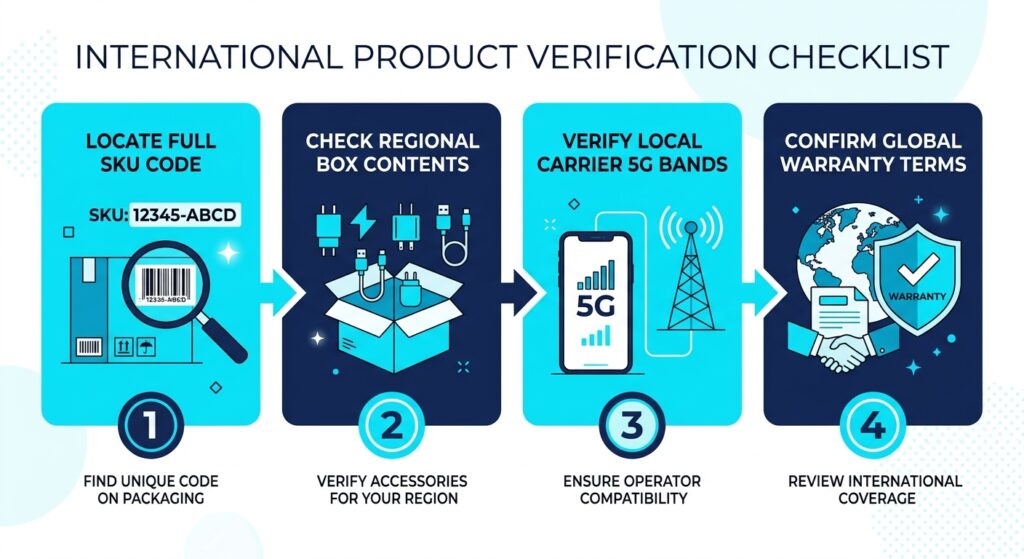
Four-step workflow for checking an international product variant before purchase.

Locate the Full Model/SKU Code: Record the complete hardware model and sales code. Do not compare only names such as “Pro,” “Ultra,” or “Series 7.” Apple and Samsung both maintain support pages that identify devices by exact model numbers. Cross-Check “In the Box” Content: Read the official page for the country of purchase. Confirm whether the adapter, cable, case, mounting hardware, battery, remote, or other required part is factory-included. Treat promotional gifts as separate items.

Verify Cellular Bands and SIM Support: Compare the imported model’s supported LTE and 5G bands with the intended carrier. Also check eSIM availability, physical-SIM support, Wi-Fi frequencies, and carrier-lock status. Review Global Warranty Terms: Warranty coverage is not automatically worldwide. Apple’s U.S. warranty, for example, states that service for iPhone and several other products may be restricted to the country where Apple or an authorized distributor originally sold the device. Service options and replacement-part availability can also vary by country.

Products with the same appearance or marketing family can differ by model code, radio support, SIM arrangement, software features, compliance labels, accessories, keyboard layout, and warranty terms. Other regional differences may involve only naming, colors, packaging language, pricing, or temporary store promotions. Do not assume that every variation is caused by consumer psychology, climate engineering, environmental law, or cost cutting. Those explanations require evidence for the specific product. Core Actionable Takeaway: Compare the complete SKU, official regional specification page, factory “In the Box” list, network compatibility, power requirements, and written warranty terms before purchasing an overseas version.

Categories
Business

When a Broadcast Schedule Guide Is More Reliable Than a Search Engine for Finding Older Programs

A general web search is useful when you know only part of a program’s title, an actor’s name, or a broad period when it aired. It becomes less dependable when the question requires an exact date, time, channel, station, or regional edition. Search engines organize indexed web pages; they do not function as complete television-history databases. A contemporary newspaper listing, regional TV guide, or broadcaster schedule can provide evidence that is closer to the original broadcast period. These records still need to be interpreted carefully because published schedules sometimes changed before transmission.

Why Are You Searching in Vain on Google and AI for Historic TV Broadcast Schedules?

Modern search tools can lead researchers to useful archives, but they have clear limitations when the underlying records are incomplete, inaccessible, or poorly indexed.

Google’s Algorithm Does Not Rank Results by Historical Authority Alone

The original claim that Google primarily favors advertisements, traffic volume, and commercially valuable pages is inaccurate. Google states that organic ranking is generated programmatically through multiple systems and signals, and paying for advertising does not improve a page’s organic position.

The practical problem is different. A search result may identify pages that match the title or keywords without determining which page is the strongest historical record. A current streaming page, fan article, shopping result, episode guide, and scanned newspaper may all refer to the same program for different reasons.

Older listings can also be difficult to retrieve because of OCR errors, alternate titles, regional spelling, changed station call signs, or incomplete metadata. Search engines do not guarantee that every available page will be crawled, indexed, or shown.

AI Search Tools Can Produce Plausible but Incorrect Details

Generative AI can help create search terms, recognize title variations, and organize information that has already been found. It should not be treated as the original source for an obscure air date. NIST describes “confabulation,” commonly called hallucination, as confidently presented output that is erroneous or false. This can include invented historical or biographical information. An AI answer may also combine several legitimate facts incorrectly. It might confuse a production date with an air date, a network premiere with a local rerun, or an episode title with a syndicated title. Any exact broadcast claim should therefore be checked against a dated source.

Some Broadcast Records Are Not Available to General Search Crawlers

Part of television history remains in print newspapers, microfilm, library databases, internal station records, or collections that have not been digitized. Other databases require a library subscription or login.

Content behind authentication may be inaccessible to crawlers, while publishers can prevent pages from appearing in search results through technical controls. Google also notes that password protection prevents its crawlers from accessing a page. This does not make such collections part of a mysterious or inherently inaccessible “deep web.” It simply means that a normal search result may not contain the full record.

When Is a Broadcast Schedule Guide More Reliable Than a Search Engine?

A schedule guide is most useful when the question concerns what was advertised for a particular date, market, channel, or time slot. It may show that a program was scheduled in color, identify its planned duration, distinguish a repeat from a new episode, or reveal which local station carried it. However, a printed listing is usually evidence of the planned schedule, not an unconditional record of what viewers actually saw. Breaking news, sports overruns, technical faults, preemptions, and last-minute substitutions could change the broadcast.

The BBC Programme Index illustrates this distinction. Its historical schedule data was drawn from Radio Times listings covering 1923–2009. Those listings are valuable contemporary records, but published schedules did not always capture later changes or cancellations. Regional records matter in countries where local stations could preempt or reschedule network programming. A national prime-time grid may show what a network offered, while a newspaper or TV Guide edition for the viewer’s market may show what the local affiliate planned to carry.

Schedule research can also help users avoid unsafe searches for unauthorized copies. Once the correct title, episode, station, and date are established, the user can search legitimate broadcaster archives, libraries, rights-holder catalogs, and preservation collections. A historical listing does not prove that a recording survives or that it is legally available online.

Diagram comparing general web search results with dated regional television schedule records.

Guide to Finding Historic Broadcast Schedules Using Specialized Archives

Use the following process rather than relying on a single website:

[Step 1: Search Library Newspaper Databases]


[Step 2: Locate Scanned Regional Schedule Guides]


[Step 3: Contact Broadcasters or Archival Institutions]

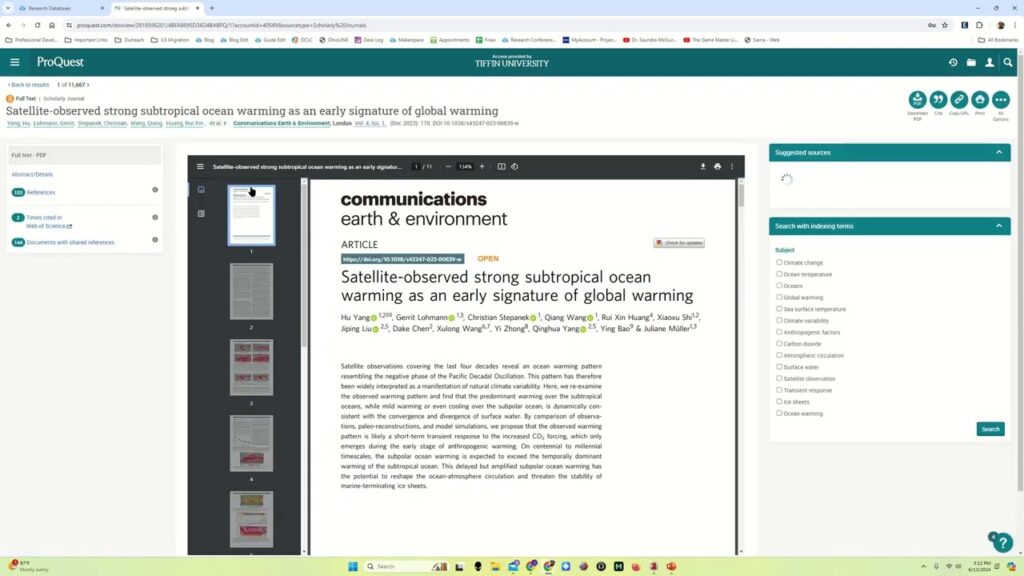
Search ProQuest Through a Public or University Library

ProQuest Historical Newspapers is a subscription collection available through participating institutions. Its global product contains more than 200 newspaper titles from the United States, Canada, and other regions, presented in their original printed form. It is not a complete archive of every newspaper in the world.

Search by date and location before searching by program title. Historical OCR may misread short titles, station call signs, or small schedule-grid text.

Useful searches include:

television listings + city + exact date

station call sign + program title

TV schedule + newspaper name + month and year

Open the full scanned page whenever possible. A text result without its page layout may separate a title from the wrong time or channel.

Use Internet Archive and Other Scanned Magazine Collections

Internet Archive contains individual TV Guide issues and user-created collections, but coverage is uneven by year and regional edition. One available collection, for example, contains Northern California issues covering five years from 1965 to 1970. Other separately uploaded issues cover different dates and markets.

Search for the location as well as the year:

TV Guide 1977 Los Angeles

TV Guide 1985 New York

television listings Philadelphia 1991

Do not assume that a search for “TV Guide 1980” returns the edition for the required city. North American editions could contain different station lineups and local schedules.

For BBC programs, the BBC Programme Index is generally more useful than an unrelated TV Guide scan because its historical listings derive from Radio Times.

Contact Local Broadcasters or Relevant Archives

Contacting a broadcaster can help when the program was locally produced, preempted, or absent from national guides. Include the approximate date, station, market, host, possible title variations, and the reason for the inquiry. Do not assume every station still has complete logs or staff available for private research requests. Ownership changes, disposal policies, and incomplete preservation may have created gaps.

University collections, state libraries, historical societies, and broadcast museums may hold records even when the current station does not. The American Archive of Public Broadcasting, for example, brings together records and digitized material contributed by more than 200 public media stations and archives. Its holdings are substantial but focus on public broadcasting rather than every commercial schedule.

Three-step workflow for researching an older television schedule through newspapers, scanned guides, and broadcaster archives.

Verified Scope of Specialized Schedule Platforms

Community-maintained schedule databases are useful starting points, but they should not automatically be treated as primary evidence. Their current documented scopes are:

Archive Platform Name Data Scope & Archival Timeframe Key Features & Research Value
epguides.com More than 12,800 episode lists, with its chronological menu beginning in 1946; U.S. fall prime-time schedule grids are also available for modern seasons, including archived grids from at least 2002 Useful for episode titles, listed air dates, and planned U.S. network grids. It is not a complete local-station schedule archive.
Daytime TV Schedule Archive U.S. network daytime grids beginning in 1947 and continuing through sections labeled “2010–Present” Focuses on daytime network changes. Its FAQ says the project draws from TV Guide editions, newspapers, trade publications, and reference books, and accepts corrections after checking other sources.
classic-tv.com Its current schedule index links U.S. prime-time season grids from 1950–1951 through 2007–2008 Helpful for broad seasonal network lineups, but it does not provide date-by-date local schedules and should be cross-checked with contemporary records.
tvtango.com Date-based television listings described by the site as covering dates since 1950 Useful for searching past and present listings by date. Because it is a secondary online database, important findings should be confirmed with a newspaper scan, regional guide, or broadcaster record.

Comparison of episode guides, network schedule grids, daytime archives, and original newspaper listings.

A broadcast schedule guide becomes more reliable than a general search result when the question requires a specific date, channel, time, market, or regional variation. It is especially valuable when the guide is a contemporary newspaper page or regional edition produced near the date being researched. It is not automatically proof of the broadcast that occurred. Schedule changes, preemptions, OCR errors, incorrect metadata, and missing editions remain possible.

Use AI and Google: To identify title variants, actors, stations, approximate dates, newspaper names, and likely archive collections. Cross-Reference Direct Historical Archives: Confirm the result with a dated schedule page, regional guide, broadcaster record, or multiple independent sources. Record the publication, edition, page, market, date, and whether the source shows a planned schedule or an actual transmission log. This method does not guarantee 100% certainty in every case, but it produces a traceable conclusion supported by evidence rather than an uncited search snippet or generated answer.